We Are Part Of Something Bigger

I don’t mean that in some ass backwards magical woo woo way of thinking. I mean that in a grand cosmic sense. If that makes sense… We are the atoms that make up the matter that makes us. We interact with and manipulate all kinds of other objects and conglomerations of other bits of matter every day. We are material things in a material world (damn I said that?) Our world as we know it is a huge complex and diverse system, where all of the parts make the whole. All that we know is contained on a tiny little planet, in a tiny little solar system, in a tiny little galaxy, in a tiny little galactic cluster, that… whew! Is part of an enormous super cluster.

If you have been around the web in the last couple of days, you have probably seen this video.

That is an amazing video, with some incredible science.

What gets me is, for a long time we suspected a huge gravity well at the core of our galaxy, now we know it is there, (black holes) and we strongly suspect they are at the core of every galaxy, as well as spread out here and there throughout the universe. Now what this finding shows, and it concerns my little mind a little bit, is there is some kind of enormous gravity well that is attracting most of the galaxies in our super cluster. Now what in the heck could be the source of that gravitational attraction? One so large it is pulling much of an entire super cluster of galaxies to its center?

…and the grander question, is this entire scenario a small part of something much much bigger? Where does the infitismal accumulate to the exponential conclusion, that point to where there is no going beyond? Where does it end exactly? What is the end of the line of that always growing place in our understanding, of that which we are such a small part of,  which could be infinite?

I guess if it is infinite, we will never know. But dammit I want to know where it goes from here. 🙂


Duck! Near Earth Asteroid to Miss Us by 25,000 Miles!

Holy cow that’s close!

http://time.com/3267989/asteroid-earth/

25,000 miles is 1/10 the distance to the moon. Considering how big space is that is a razor close shave.

This asteroid was discovered by the Catalina Sky Survey at the University of Arizona over the weekend. It is estimated to be around 60 feet in diameter, and is supposed to pass over New Zealand when it comes through. The article points out it will not be possible to see naked eye, but a telescope should resolve it. I am sure someone will get a good pic of it that will make its way to the internet.

You never know when you get up in the morning, what kind of day it will turn out to be. Imagine if that thing were to hit close to home. Man I am sure glad it is a miss…this time.

Andromeda

One of my usual blog stops is over at Phil Plait’s Bad Astronomy blog, and this morning he has an exceptional astro photo and a small write up on this enormous galaxy. Andromeda has been one of my favorite objects to view through a telescope for many years, and I can spend up to 30 minutes at a time observing it before I move on to other night sky treasures. His blog post got me to thinking about Andromeda, so I thought I’d throw some cool Andromeda stuff out there.

What is the farthest object you can see with no optical aid? Andromeda of course. It lies 2.5 million light years away and is visible as faint smudge in the sky on a clear night.

(EDIT EDIT EDIT: My big dumb ass just came in from outside (it’s dark) and the moon is past 1st quarter which I should have checked on before I went all smartypants with this postYou see it takes a moonless night for these naked eye objects to be easily seen. As well it helps to dark adapt your eyes for 15 or 20 minutes before you attempt to hunt them down. Also it helps a LOT to be far away from city lights, a fairly dark location is very helpful. So keep these things in mind if/when you decide to take a shot at finding them.)

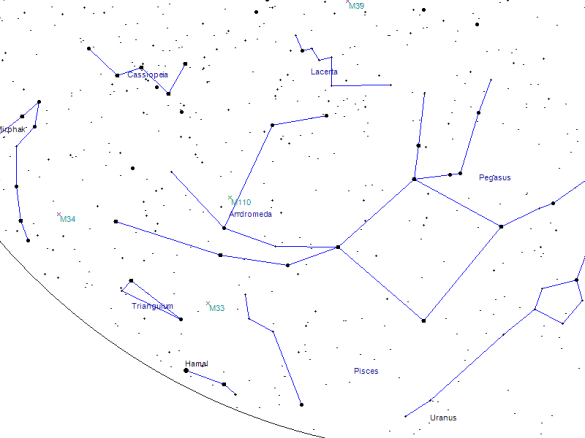
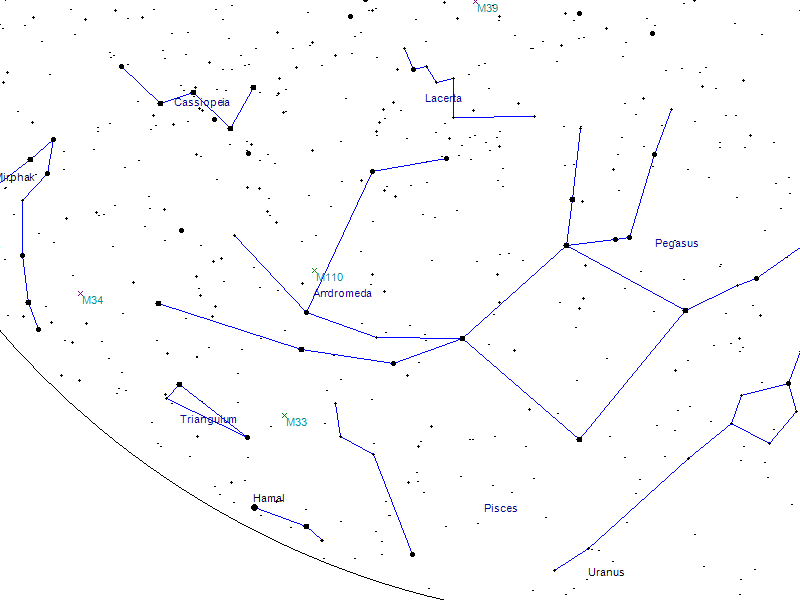
Where do I look? To the NE sky anytime around 9-10 PM will do. This location won’t be too far from the horizon this time of year at that timeline. Later in the night it will climb higher in the sky. Here is a wide look at the region. Just about everyone knows the familiar constellation of the beautiful goddess Cassiopeia. There is a handy pointer built into Cassiopeia pointing you in the general direction.
 

Andromeda

Cassiopeia to the upper left, with it’s built in pointer pointing towards the constellation Andromeda, which just happens to border, and share a star with the Great Square of Pegasus. I always have looked at the Andromeda constellation simply as an extension of Pegasus, being the mighty winged horse’s back legs. That isn’t how it is supposed to be, but if you look at it that way it gives a nice fluidity to the Pegasus constellation that I like.

Now that we have a sense of where we are looking and what we are looking at, follow those hind legs of Pegasus halfway out from the Great Square. There is a pair of easily visible stars lined up there, these two stars are my line of sight to finding the Andromeda galaxy. Take note of the separation between the two stars, and double it (heading upwards in this chart.) Bingo! There lies the galaxy. The chart shows the location of one of Andromeda’s companion galaxies, M110, but not the location of Andromeda itself (M32) which is odd. The location for M110 will be roughly the same for M32.  However when you are looking at that part of the sky all that matters is those two stars, double the distance, and you will hit Andromeda. 🙂 …You have no idea how difficult it was to find a chart that was useful for pointing out this location. Sure there are hundreds of charts out there, but many with too much info such as gobs of constellation lines, and gobs of stars, and such. And many with too little information, or too close in of a view, or a view too far out. This post was an exercise in dedication! Anyway…

On a good clear night the Andromeda galaxy is just a small fuzzy spot by naked eye observation. But, knowing that what you are seeing is a huge galaxy 2.5 million LY away makes it a pretty neat experience. Move up to a pair of binoculars and it really comes alive, becoming a much larger fuzzy spot. (yeah, us astro geeks get thrilled when a small fuzzy spot turns into a larger one) but now you can identify a brightening core at the center. Moving on up to a small telescope more details can be teased out of the view including a dust cloud in one of the spiral arms. Using my 12.5″ Dobsonian telescope the view is breathtaking. The galaxy is huge, requiring the necessity of slewing the telescope around to take it all in. Now 2 dust lanes are easily visible instead one one, and there are two companion galaxies close by that are always on the target list. Like I said before, I can spend a lot of time observing this object, it is easily one of the top 3 objects us amateurs enjoy.

More cool stuff…

Oh my gosh, it’s heading right for us! (South Park reference) But it really is, at about 70 miles per second! (or if you prefer 250,000 mph!) They believe in around 4.5 to 5 billion years it will collide with our galaxy. By that time our sun will have gone red giant anyway, so this collision will doubtless go unnoticed by us puny humans. At least from the perspective of this planet, and that notion is probably far too optimistic for our species, given the state of the world today.

Will 2 enormous galaxies colliding make for all kinds of star collisions, and orbital dysfunction? Probably not so much. You have to understand the vastness of space, think about standing atop a hill. Now imagine a guy with a shotgun that has gravity defying pellets. This guy is standing 100 miles away and shoots the shotgun right at your location. Will you get hit? By the time those gravity defying pellets spread out over 100 miles it would be extremely unlikely you would get hit by one. Same for the stars in our galaxies, they are so far apart the likelihood of a collision is small.  Following the shotgun with gravity defying pellets analogy, now imagine two shotgun wielders pointing their shotguns towards each other at a 100 mile range. Again the pellets will be so widespread, there is very little chance of any colliding. There will however be an interaction between the the dust, and gases that both of our galaxies harbor. These dust clouds would interact very agressively,  making for a huge burst of star formation, too bad we won’t be here to see it…

The Andromeda galaxy was huge in Edwin Hubbles research. First he discovered that Andromeda was actually another galaxy like our own, and not another object within our own galaxy. His observations also helped us to understand the distances between our two galaxies, and distances between other objects. Later in his career, by making critical observations, and submitting a paper on the subject, he was credited with the observational proof that our universe is expanding. At an incredible rate to boot. His work also led to our understanding of redshift velocities being consistant with Einsteins Relativity Theory. Which in turn led to observational support for an expanding universe. A notable distinction between a hypothesis with no evidence, and one with verifiable evidence!  No wonder this guy got an incredible space telescope in his honor.

Well, if you have followed me this far, there is another smudge in the sky you can also see with no optical aid. It is known as the Double Cluster. Find Cassiopeia again, and follow the constellation lines from right to left on the chart. Those last two stars will help you spot the cluster. Use those two stars to form a slightly elongated triangle, (heading SW on the chart. Note that the chart may not line up exactlywith the sky you are looking at, you have to adjust your point of reference to the chart.) There lies the smudge. This object is a star cluster within our galaxy. Actually two small clusters. You will need binoculars or a small telescope to resolve them beyond a smudge.  But you can see it is there with the naked eye.

Well that wraps this one up. I hope if anyone gets a chance, go have a look. Looking up has its benefits.


Venus and Jupiter Dance In The Early Morning Sky

Check your forecast. If you have any chance of clear skies in the early morning, get up outta bed and look to the eastern skies, just before sunrise. Venus and Jupiter will be as close to each other in the sky as they have been in a long time. How close? Less than a 1/2 a degree apart. How close is that? Damn close. If you have a telescope you will easily fit both planets in the field of view.

If you don’t have a telescope, do you have binoculars? Binoculars will give a great view of this event. If you have neither a telescope or binoculars you don’t need them! All you have to do is look to the east in the morning twilight. You will see two very bright “stars” quite close, this will be what you are looking for. Venus will be the planet on the left, Jupiter on the right.

There is a bonus! Just to the left of Venus there is a well known cluster of stars known as the Beehive (a.k.a. M44)*  in the constellation Cancer. If you are early enough you should be able to make it out pretty well before the sun starts to wash it out. You will need optical aid to see the cluster most likely. It can be seen naked eye as a small fuzzy patch, on a really clear night when it is further from the sun than it is now. As it is right now, probably not a naked eye object. Binoculars should be able to tease it out.

* After the great comet hunter Charles Messier who documented many objects in his hunt for comets. The Messier Catalogue is a list of many objects he kept track of, that to him just were not comets. To astronomers today both pro and amateur these objects are treasures in the sky that we make efforts to seek out and observe.

I Saw The Supernova Last Night

First I’d like to say it’s good to back. I went to the Dr. about a week and a half back with a temp of 102. Doc says, “you have an ear infection, but with your symptoms let’s do a flu screen.” I also had H1N1. Let me tell you I would not wish that on anyone, not even my redneck neighbors. Chills that have you shivering one minute, hot flashes that have you sweating the next, body aches from hell, headaches from coughing like there is no tomorrow, and a general feeling like a giant bird flew overhead and took an enormous shit on you. That was as sick as I have been in a long time, I still haven’t quite shaken a nagging cough, but I also still have a few antibiotics to take. Anyway, if you can get the flu shot, I highly recommend it. I have a mild egg allergy that makes my Dr. recommend me not getting a flu shot. I think I’d rather risk the side effects of having the shot vs. having the flu next time…

Now, in case you haven’t heard, a new supernova blew up in a galaxy several days back.  This galaxy I have observed many times, M82. M82 is  sometimes called the “Cigar” galaxy due to its cigar like shape (obviously) It is located in the constellation Ursa Major which happens to be positioned for good viewing right now which is great. Anyway we had a break in the clouds last night and I was determined to get a look and see if I could spot this supernova, plus it was supposed to cloud up fairly quick and start with some flurries, so I was feeling a tad desperate. Using a 12.5″ scope and a low power eyepiece I scanned the area where I know M82 to be and found it fairly quickly. Even in the low power view I could see the supernova. I doubled the power with a 17mm eyepiece and it was very obvious. I made the entire family brave the cold and come out to see this, it isn’t very often you get to see a supernova, in another galaxy, that it so easy to see. It doesn’t actually look like much, it appears as a fairly bright star about one half to two thirds of the way out from the galactic core. What makes it spectacular is what it is you are seeing. A star that blew up sometime around 12 million years ago, just became visible to us from our vanatge point in the universe. That is the cool part.

Of course with the Great Orion Nebula M42 overhead, I had to have a look at it, and Jupiter was begging for a quick look. That was all I could handle and wrapped that observing session up right quick. It was pretty cold, with a wind blowing, and man we have had a LOT of that this winter.

For more on the supernova, with explanations and maps and pictures: http://www.universetoday.com/108386/bright-new-supernova-blows-up-in-nearby-m82-the-cigar-galaxy/

Free Floating Planet

Image


http://www.ifa.hawaii.edu/info/press-releases/LonelyPlanet/

A planet has been discovered floating free in space, not attatched to a star. This is the first discovered with this distinction.

Over the last few years, quite close to 1000 planets have been found orbiting other stars besides our sun. Which is really cool. That was to be expected, stars form in nebulous clouds of gas and dust, just as our sun did. It also stands to reason that most stars, would have planetary systems as we do. The investigation in the matter proves conclusively that this is so. Science for the win!

It has also been suggested that during the planet forming stage, or just after, when the orbits are being worked out, that the possibility exists that a fledgling planet could be flung out into space. Again scientific investigation, lends credence to the idea. This looks like a smoking gun to me.

Moral of the story, science is working diligently every day to test new ideas. When these ideas are confirmed, it is cause for a moment of celebration. Then when that moment passes, new questions arise, which need looking into, and that is why science is awesome! There is no end to inquiry, there are standards to be met, there is no room for bias or preconceptions, there is a never ending investigation into the why and the how, it is this desire to learn that makes an (yep, I’m gonna do it) Evidence Based Reality the king of the school of thought.

On a personal note, I was out last night with the big gun (12.5″ telescope) observing Uranus and Neptune. There is nothing quite like looking at a planet that is very close to 2 billion miles away (Uranus) and close to 3 billion miles away (Neptune) and seeing them with your own eyes. I also took time to look at a few deep sky objects one of which being the Andromeda Galaxy and it’s companion galaxies, The Ring Nebula was spectacular at nearly 300x, then I just dropped in a low power wide field eyepiece and just cruised the Milky Way for a while. It was fun, you should have been there 🙂


The Comet Is Coming!

Image

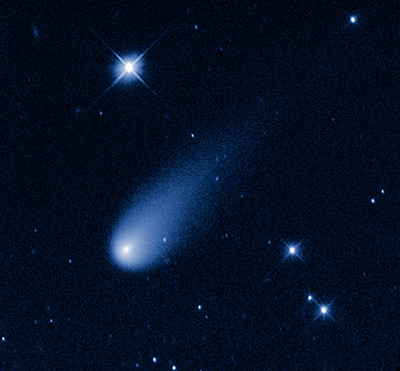
ISON is it’s name, comet-ary awesomeness is it’s game. It will be here in Nov. I cannot wait. This one has the potential to be the comet of the decade, or even of the century. Scientists think this one could get so bright it can be seen in the daytime. At the very least it should be a naked eye object from dusk to darkness. 

The last time we had a “comet of the century” event, it was Kohoutek back in 1979, which fizzled and failed spectacularly to meet expectations, comets are notoriously difficult to predict accurately, but this one has the potential to be a whopper. Anyone with binoculars, or a pair of eyeballs should get a kick out of this one, even it only meets half of its expectations. I am so looking forwards to this event.

A few details from the Hubble site:   http://hubblesite.org/newscenter/archive/releases/2013/24/image/a/

Stellarium

I am probably the last guy in this county to get a cell phone. I live so far out in the stix that the sunlight we get is already a day old. I’m that guy that will be late for his own funeral.

I only very recently acquired a laptop when most kids these days have every electronic gadget known to man. So I am probably very late in discovering a fantastic astronomy program that is available as a FREE download. It’s name is Stellarium. 

If you are a backyard astronomer, or just enjoy looking at the night sky, this is a must have program. I have tried a few other well known free astro programs that are also very good, and quite usable, with lots of neat stuff, but Stellarium is just so smooth. What I mean, is when you want the sky to scroll around to another area, the motion isn’t laggy or jumpy, or feels like it is uncoordinated. It is smooooth. The sky is very realistic as well, sharp even, with  a very natural feeling color. You can adjust every setting you can think of, to suit your depth of sky knowledge. You can use a plug in to enter your eyepiece and telescope stats, that will show you a field of view that will be just like what your telescope or binoculars will see when you look at an object. This feature alone is an incredible resource for anyone looking for a certain faint object, or identifying something you did not know existed when you are panning around. 

I simply cannot imagine another observing session without having Stellarium by my side. Even though I am pretty much a minimalist, which means I try to get everything I need out the door, in 2 trips with no exceptions. This will be worth the 3rd trip, and running an extension cord. And that is about as high a praise I can think of. 

Get it, FREE, here: http://www.stellarium.org/    Across the top of the page are links for your system, just click the one that is right for you, and open up a new window into the night sky. Your download will begin. It is only around 80 MB. Don’t even think about it, click the link!

It is Awesome with a capital “A”, and you can’t beat the price.


Galaxy Interactions

Image

penguingalaxy

Hubble never ceases to amaze me. This picture of two galaxies, one essentially ripping the other apart, is gorgeous. Never mind the fact that when you look at it it resembles a penguin (NGC 2936), guarding its egg (NGC 2937). This combination of galaxies is known as ARP 142. I am probably an odd sort, as I always like to play “spot the other galaxies” in Hubble pics, I can see at least 10 that I’m pretty sure of, there is probably more, and no I don’t have anything better to do…

What I find intriguing here, is that usually when two galaxies interact there is a mutual warping of structure. In this case, at this point in time, the fuzzy blob galaxy (NGC 2937) appears unperturbed while the penguin (NGC 2936) is being ripped to shreds. The penguin was before this incident, an often seen spiral galaxy. The fuzzy blob was and still is what is known as an elliptical galaxy, that seems unconcerned of its devastating force being exerted upon what once was a beautiful spiral structure.

I wonder why is the NGC 2937 not noticeably distorting? Is its gravitational pull so strong it simply overwhelms the penguin? If that is the case, it must be a hugely dense galaxy. I wonder what an infared pic might reveal here? I also wonder when the penguin gets pulled closer and closer, will the fuzzy blob inevitably begin to distort? I can’t imagine that not being the case. Only time will tell I suppose, and I won’t live long enough to know the answers. In the meantime I can only look on in amazement as the galactical drama unfolds. Reality TV at its best.

Something else I’m curious of in the pic, is the filaments of darker material, that often lines the arms of spiral galaxies. Much of it appears to have been yanked free of the spiral arms, and has formed into the long strands that seemingly are being sucked down the drain, so to speak. As if, during the reshaping process, that matter was distilled out of the arms, and coalesced into the cloud-like strands seen here. Or maybe it is just loose material swept up in this reorganization. I do hope someone with a better grasp of this situation does a full write up, so I can get a better understanding of what is going on.

More here: http://www.sciencedaily.com/releases/2013/06/130620132225.htm

…and much more needed to satisfy my curiosity. Paging Phil Plait…


EDIT: My favorite professional astronomer Phil Plait,  got around to doing a blog post on this subject. So for more info on the matter (pun?) go here:

http://www.slate.com/blogs/bad_astronomy/2013/07/15/galaxy_sculpting_cosmic_collision_shapes_a_galaxy_into_a_hummingbird.html

Black Holes Galore

Image

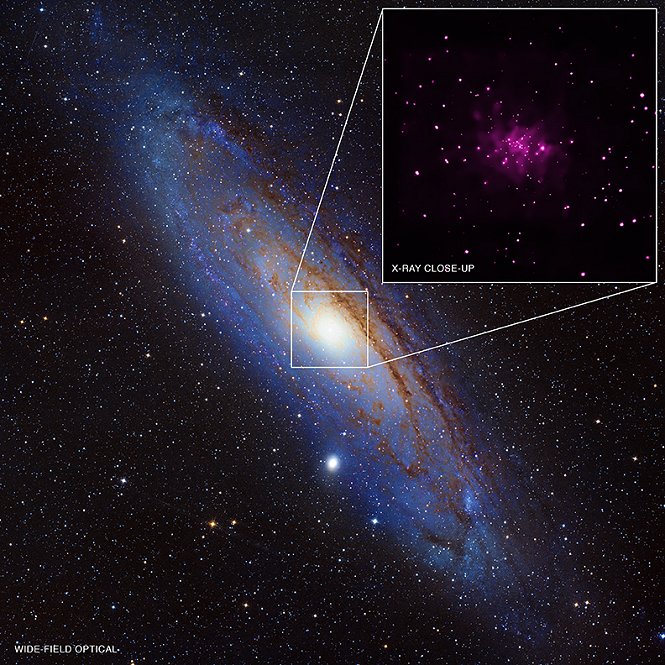
NASA’s Chandra observatory has with a recent observation, turned up several more black holes, than previously known, near the center of our closest galactical neighbor Andromeda. This survey has raised the number of known black holes there from 9 to 35.

http://www.nasa.gov/mission_pages/chandra/news/bonanza.html

One of the interesting findings, is that some are associated with globular clusters. Globs as they are appreciatively known by amateur astronomers, like yours truly, do not have that distinction in our own galaxy. At least as far as we know at this point in time, it is kind of difficult to observe your home galaxy in a detailed manner, due to the predicament of being located in said galaxy. Hard to get a distant perspective, plus the fact that all kinds of dust, and accumulated matter, make it difficult to peer inside our galaxy, making a thorough investigation difficult at best. The article goes on to explain that Andromeda’s central bulge is quite a bit bigger than our own, allowing more black holes to form. I doubt I will live long enough to see if there indeed is a chance of a glob in our galaxy sporting a black hole. It is the possibilities, and the desire to know, that keeps scientific investigation alive, and imaginations working overtime. (I think I am safe to assume, that not all of the existing globs in our galaxy have been discovered, or shown to not have a black hole. As always, I am open to evidence)

At any rate, I love to observe globular clusters, and galaxies when I’m cruising our galaxy on a moonless night, with my small yard cannon, a 12.5″ Newtonian telescope. Planets are fun too. Oh and planetary nebula’s, and double stars, and catching a stray meteor when I’m out there looking up, and supernova remnants, and open clusters, and stellar nursery’s, and yeah…I’m a geek.