Eclipse 2024

Welp, our first plan was to head for Ravenden Arkansas. Four minutes and 12 seconds of totality. But the weather started looking iffy, and it would mean we’d be away from home for probably 10-12 hours before we got home. Which is fine for us, but the three dogs, and two 2 cats, might have had an issue or two with no one being here for that long. So, that sealed it, we were staying home.

It was said we’d get 97% coverage here, and that ain’t bad. But it’s not totality. If you have never experienced totality I can only describe it as a few minutes of almost creepy lighting, that is very mesmerizing, something about it, you want to soak up every second of the experience, and then it’s gone. Gone too soon. You wish there was more.

We got a few minutes of that creepy lighting, that casts an unusual pall on the surroundings, but it didn’t last long. Very soon the moon was retreating, never reaching totality. Which was a bit of a bummer. But hey, it was at home. We made the best of it.

I have an Orion ED 80mm apochromatic telescope. Excellent glass. This scope was mounted on my Celestron CG5 mount, with tracking. It was outfitted with a full aperture solar filter. I have another small 90mm achro refractor, that I use as a projector. I set up a white board, and focus the image of the sun/eclipse coming through the telescope, on to the white board. 100% safe to look at, as is the other scope with the full aperture solar filter.

I have some ding dang eclipse glasses. Bought them for the last eclipse. Thought I knew exactly where they were. But dammit, even after turning the house upside down and shaking it three times, those little bastards never were found. My luck, I will trip over them before I go to bed. We were still able to observe the eclipse directly though, by passing my welding helmet around. πŸ˜‰

I have a little 16 mp Sony Cyber Shot camera, that I made a contraption for, that allows me to secure it to an eyepiece in a telescope. I’ve taken numerous pics with this little rig, it works. Speaking of pics… This was my first one of the day, just to make sure things were working. You can see some sun spots, and the focus isn’t great. It looked decent through the eyepiece, but I was battling lots, and lots, of clouds, often being totally obscured, and the seeing was terrible. Even when it seemed clear there were wispy clouds in the way almost 100% of the time. But I persevere. EDIT: These pics will enlarge if you click on them.

After that shot a huge cloud moved in, and by the time I could finally get another pic, the eclipse was underway. I missed first contact!

Well, it’s on! All I can do is wait for opportunities between the clouds. Drinking iced tea, passing the ole welding helmet around like it was a fat doobie, and taking pics when I can. πŸ˜‰ FYI, the pics that are whitish, means the cloud cover was thick. The yellowish pics means the cloud cover wasn’t as bad. I’m not sure it was ever perfectly clear.
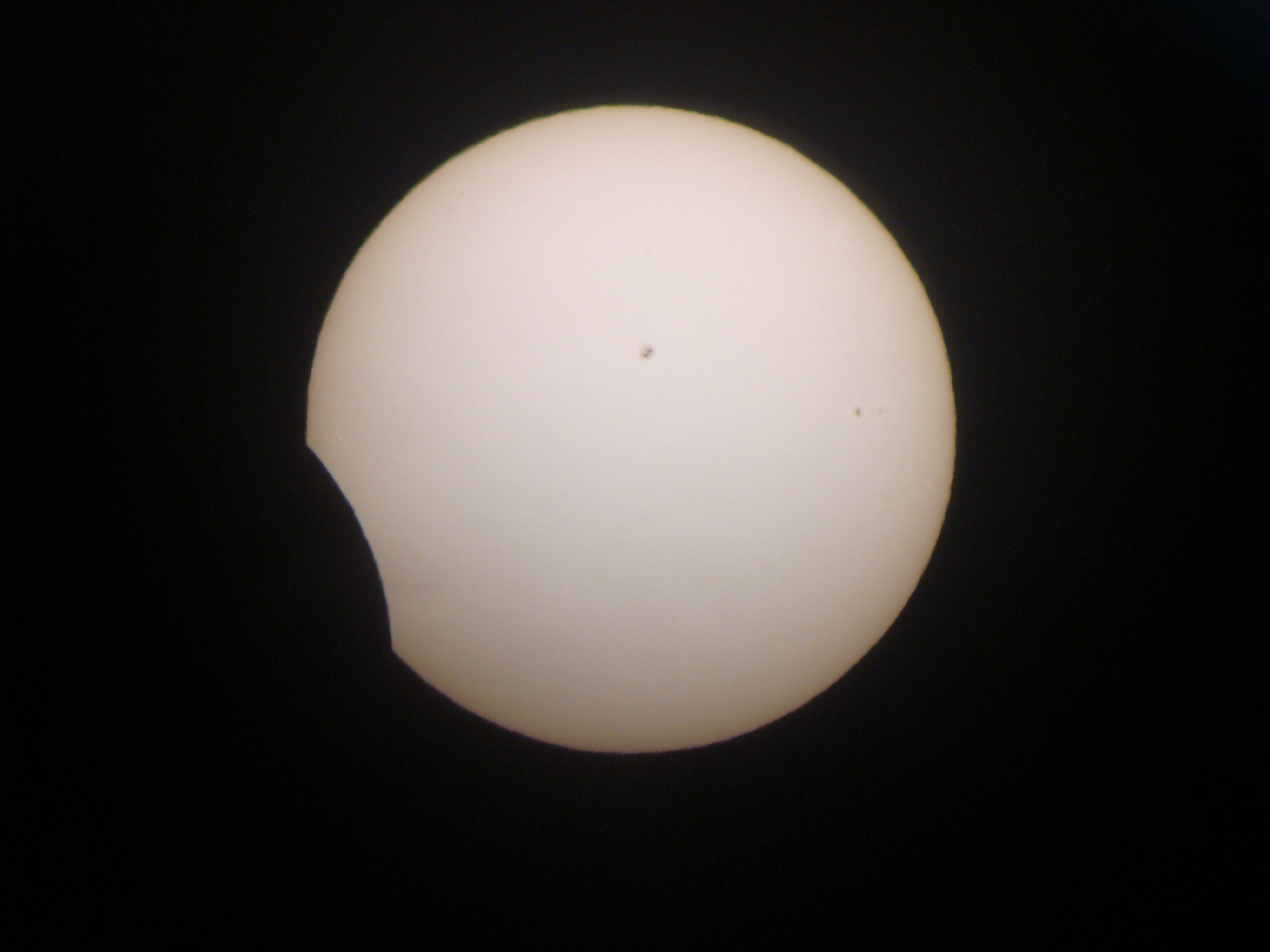
You can see the moon steadily eating away at the sun. Closing in on that sun spot. This next one was right at the edge of the sunspot.

Sunspot long gone now.
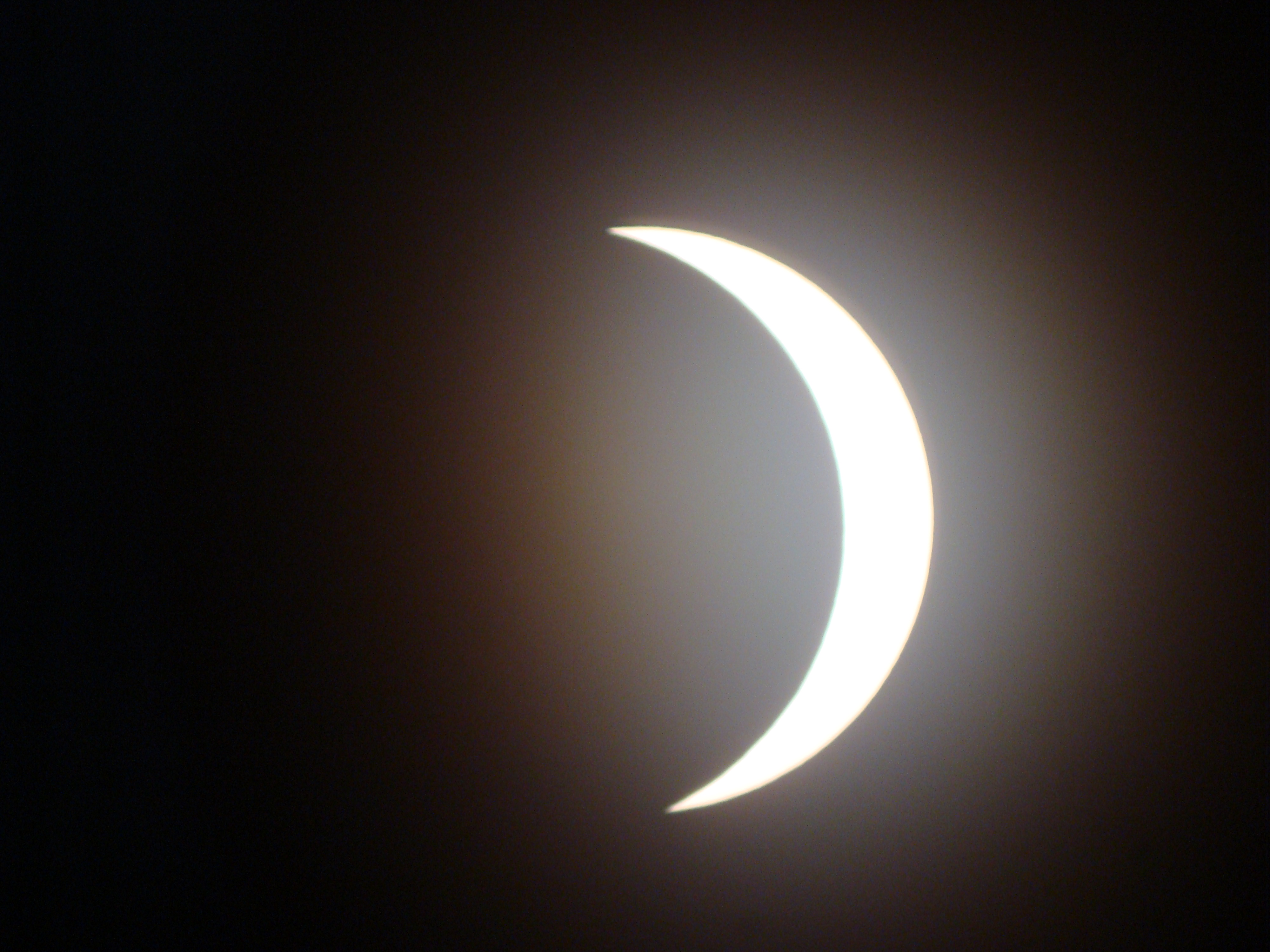
This next one, was about the maximum coverage for our location. With an optical doubling of some sort…

Now we are heading back the other way.
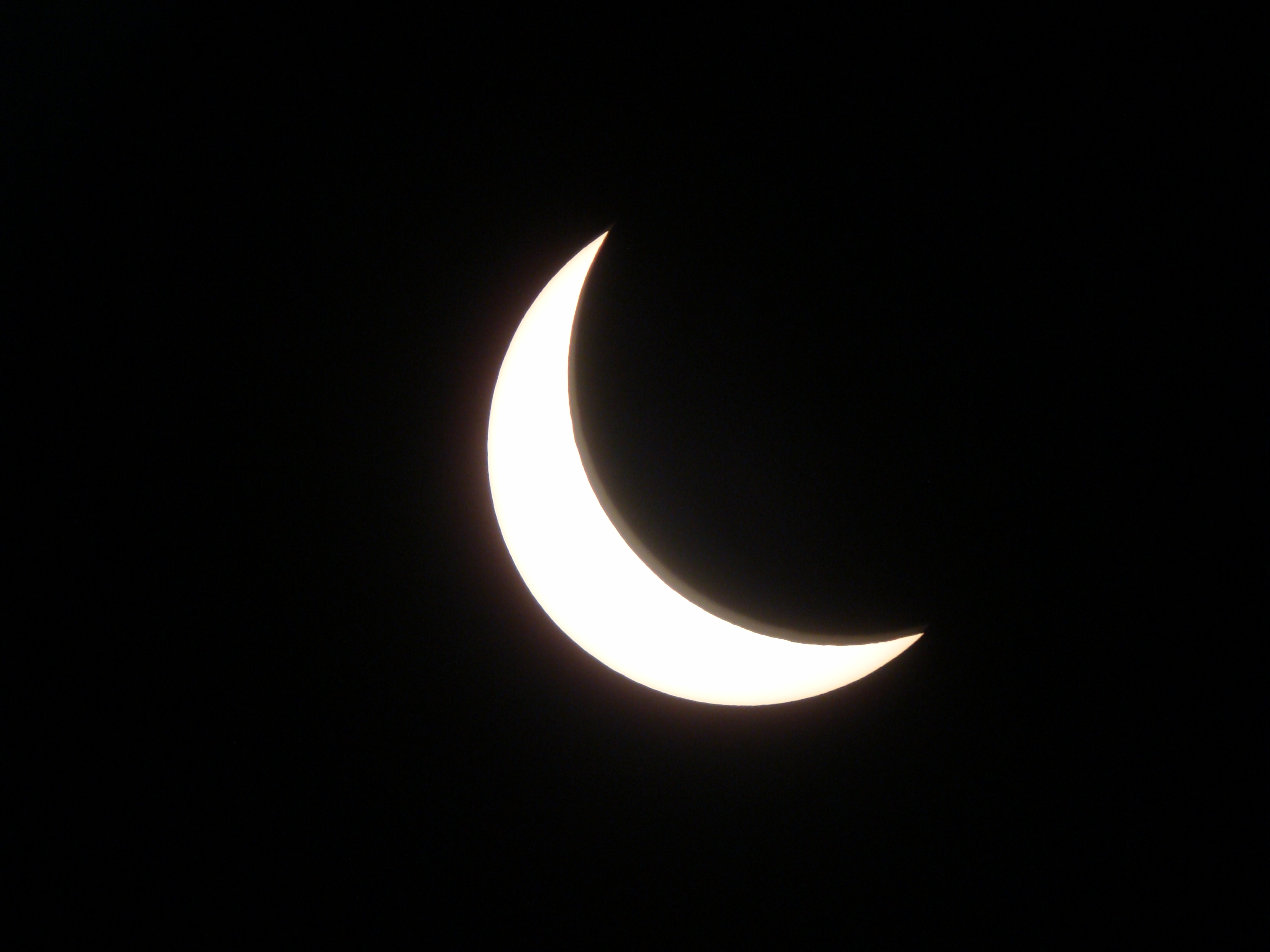
Now, as I mentioned earlier, I missed out on first contact. So I was hoping to catch final contact. I’m steadily taking pics every few minutes. I heard an airplane buzzing around, I was too concerned with what I was doing to pay it any mind. But as I was waiting for the camera to shoot (I use a 10 second delay, so that my touching the camera, which causes vibrations, that 10 seconds will allow them to settle down before the camera takes the shot,) So the camera takes the shot, then a second or two later the camera shows the pic you caught. NO FUCKING WAY! Thats’ exactly what I said when I saw the pic.

Are you kidding me? No fucking way! But there it is. Sometimes, you just have to be in the right place, at the right time, and shit happens. I can’t win the lottery, but every great once in a while, I manage something pretty cool. Okay, back to pics, but damn… You will see us working towards final contact.

And this was as close as I could get before the clouds completely obscured me again.

Not a bad day. Wasn’t the best eclipse I’ve experienced, but all in all, for being out in the front yard, not bad at all. Got to share the day with family, got to enjoy the show, with all the comforts of home. I’ll take it.

Hope you guys and gals had a good eclipse.

Nuther EDIT: Just in case anyone notices, the sunspots appear to have changed places on the sun in the later pics. My equatorial mount had gone as far as it could in the original orientation. After a time, while tracking, the mount got to a point where it was interfering with itself. So I had to finagle the mount around to another position that would work, which meant I had to turn the diagonal that the eyepiece is in, which the camera is attached to. That change of orientation, caused the sunspots, and even the way the moon appears as it blocks the sun, to change orientation. Any oddities there, are strictly from moving the mount, and/or diagonal around. Doing visual astronomy those things matter not at all…

COMET ALERT!

Comet Neowise, and I just heard about it a couple days ago (I’m slacking) is putting on a good show right now. Unfortunately this one is better suited for those at northern lattitudes. It is quite low in my Tn. sky. Probably a few hundred miles S of me it will be tough, if not impossible to see. I apologize to my southern lattitude readers! The internet will help you see it, but that experience while still good, it just does not measure up to seeing things like this with your own eyeballs.

I went out early with a pair of binoculars this morning, I was up anyway helping the wife get off to work, and searched the NE sky for it. I was stumped at first, I couldn’t find it, then I started looking a little further N and happened across it. It has a spectacular well defined nucleus and a faint-ish long tail. It somewhat resembled an exclamation point low in the N/NE sky.

By the time I got my grab n go telescope setup for a quick view some low level clouds had moved in and while the wife got a look at it, it didn’t look as good as it did a few minutes prior in the binoculars.

But hey, this comet will be with usΒ  for a little while yet, and I will be heading out every morning I’m able to see it. A decent comet is quite a treat for an astro nerd, and it will be for you too! If you have some binoculars don’t miss this one. Comets like this don’t come around often and missing them is a sin in the book of SD.

Even if you have to go to a K-Mart, a Wal Mart, or some sporting goods store to buy a pair of 10×50 binoculars (they are cheap enough and everyone should have a pair anyway!) Or beg, borrow or steal a pair from a friend, get out there and check this one out. You can thank me after you have made bail πŸ˜‰

Comet NEOWISE, the best comet of 2020


Night Lights And Negative Impacts

First off I ain’t dead yet despite some of the assumptions πŸ™‚ Life just has a way of keeping you too damn busy at times. Now back to the scheduled programming.

Researchers at the Harvard John A. Paulson School of Engineering and Applied Sciences have developed a computational tool that enhances, and I quote: “our understanding about the relationship between human activities and socio-economic factors at a global scale”

Interestingly it shows a direct negative correlation, where the existence of heavy night lighting influences some things we may never have thought of. Not to mention some reasons I highlighted from this post a while back :

Light Pollution

The researchers noted that locations with heavy night light activity suffered from, and again I will quote, though note my interjections in parenthesis: “Higher electricity consumption and CO2 emissions (obviously). Correlations with population, N2O (nitrous oxide), and CH4 (methane) emissions were still slightly less pronounced (compared to previous research) and, as expected, there was an inverse correlation between the brightness of lights and of poverty.” That little factoid there about increased poverty levels lining up with increased night lighting surprised me. Though I suppose it does make sense when you think about it.

I should also note that the GDP (Gross Domestic Product) in these brightly lit areas is also higher which I suppose is a good thing, but the question in my mind remains, is it worth all of the negatives to achieve the positive? And is it really necessary to keep these areas brightly lit at night? There are a lot of good reasons not to do that. Just no one seems to care… As I was outside just last night observing Jupiter and a few other astronomical objects, I’m one of those who do care, and I guess this is my soapbox.

Source material here:

https://www.seas.harvard.edu/news/2017/03/night-lights-big-data

On a side note I may have enough pics to get another Picture Day day up, but I have to get the time and energy to do it all. I will work on it. Finally, I hope this post finds you all well and getting along just dandy πŸ™‚

Light Pollution

This is a subject near and dear to my heart. Light pollution, for those of you who may have not heard, is the result of all of us humans who are afraid of the dark. These millions of people, afraid of the damn dark, insist on having their porch lights on from dusk till dawn, and never give a moments thought to the “insecurity lights” (a so called security light that comes on at night, giving some perception of security) that burn away all hours of the night.

Zillions of streetlights lining the streets and highways. For what? Do we not have lights on our cars? Parking lots with unshielded lighting, light blazing away long after the store has closed. Why? Stores with no one in them, lights on 24/7. Why? Does anyone even think? Not only about the light pollution here, but what about the cost? How much money does the electric company need to make?

Is anyone aware that for thousands, nay millions of years, the creatures of the night have not needed artificial lighting to find their way? No, I think the bat and the opossum and the hoot owl have done just fine without them.

Is anyone aware that all of this light actually disrupts nocturnal habits for wildlife?

Is anyone aware that due to all of this light the stars are washed outΒ so that they can’t be seen from most cities? Does anyone even look up enough anymore to care?

I do. I have been an amateur astronomer for many years. I’m always looking up. I have neighbors though who are afraid of the dark. Their outdoor lighting makes it darn near impossible anymore for me to enjoy the hobby. The light is a hideous monstrosity that is the bane of astronomers everywhere. It ruins dark adaptation, it bounces off the vinyl siding and lights up my yard to the point I could read a newspaper out there at midnight.

Safety. That word is the mainstay of the light polluter. “The lights make us safe.” Do they? No, they do not. Study after study tends to show that lighting only makes it easier for criminals to see what they are doing. So, no. Night lighting makes no one safer. The only thing lighting at night does is assuage the deluded. Those poor bastards who are merely afraid of the dark. And ain’t got the gonads to admit it.

So, what brought forth my ire this fine scorching June day? A story posted at one of my favorite haunts, Science Daily. Put out by the fine folks at the University of Colorado at Boulder. Entitled : “Milky Way Now Hidden From One Third Of Humanity.”

Now a lot of people know of the Milky Way. A bright band of stars and dust that streaks through the sky at night. This band of stars actually being one of the arms of our galaxy. There are literally a thousand treasures of the night sky hidden away in the wondrous galactic arm. I know, I have seen them. Many people have never even seen the Milky Way.

SeveralΒ years ago one of my brats had some friends over, it was a clear, beautiful evening. I had my big scope out in the yard all setup and cooled down. So I invited the kids out. When they came outside I said “Behold, the Milky Way.” And I pointed it out, and showed them how it streaks across the sky. One of them actually gasped in awe. She had never seen the Milky Way. There are so many poor, lost, misguided souls who have never taken the time to look up on a clear night.

With the advent of modern light pollution, and with the general trend getting worse, the night sky, which I consider a treasure of humanity, is ever receding away. To be lost forever for our kind. This treasure of humanity lost because people are afraid of the dark.

This first link is to theΒ “Milky Way Now Hidden From One Third Of Humanity” story. The following links are all dedicated to the premise that street lights make no one any safer.

http://www.colorado.edu/news/features/milky-way-now-hidden-one-third-humanity?utm_source=Colorado.edu&utm_medium=Milky%20Way%20now%20hidden%20from%20one-third%20of%20humanity&utm_content=News%20and%20events&utm_campaign=Homepage

http://www.treehugger.com/urban-design/new-research-streetlights-dont-actually-reduce-crime-or-accidents.html

https://psmag.com/streetlights-might-not-make-you-safer-7de92a524348#.107d00qs1

http://gizmodo.com/streetlights-dont-actually-prevent-crime-1722056358

http://darksky.org/light-pollution/lighting-crime-and-safety/

Don’t be afraid of the dark. Embrace it. Enjoy it. Look up. You might see something that inspires you. You might find someΒ serenity. You might be humbled by the vastness of the universe. There is nothing to fear in the darkness. Only fear itself.

Turn off those damned lights! πŸ™‚


Now Can They Find Our Missing Socks?

In case you haven’t heard, astronomers have discovered the missing matter in our universe. According to the current cosmological model, matter is dispersed through the universe in a 70% dark energy, 25% dark matter, and 5% ordinary matter ratio. The ordinary matter, like we all know and love, has only been measured to around 50% of what they thought was out there. This missing matter was hiding where they thought it might be, but had no direct evidence to show. Until now. This matter was assumed to be in gaseous form residing in the vast distances of space, but we had no way to measure it.

There are these occurences known as FRB’s (Fast Radio Bursts) A FBR was caught recently (last year sometime). With very quick follow ups with other observational telescopes they were able to pinpoint the location of the FRB. Using the redshift analysis they determined this galaxy is 6 billion light years out.

While we can detect FRB’s, they havent been able to get a location on one quick enough to determine it’s location. They got this one. Which is only part of the challenge. Knowing the distance is only 1 key aspect, but a big one.

Now what they know about these FRB’s is the radio waves disperse as they travel through matter in space. The radio waves with higher energy/frequency arrive before the lower frequency waves. The amount of dispersion depends on the amount of matter they encounter. This discrepency combined with the location of the event that caused the FRB allowed them ( I am not sure who they are) to indirectly measure the matter these radio waves traveled through. It fits the model!

This is kind of a big deal actually. When data comes together to confirm a working theory we have what is known as science. Science being the best way known to understand this big old universe we live in. It works so much better than thoseΒ other ways of knowing, and they can show their work!

I caught this firstΒ from Science Daily:

https://www.sciencedaily.com/releases/2016/02/160224231734.htm

Also Phil Plait over at Bad Astronomy did a great write up. I borrowed some of his knowledge of the radio wave dispersion in my write up. Mr. Plait goes into much detail, and considers the causes of FRB’s:

http://www.slate.com/blogs/bad_astronomy/2016/02/24/fast_radio_bursts_finally_identified_as_being_very_far_away.html

Wrong Place, Wrong Time

Could this be for real? An Indian man is claimed to be dead by meteorite!

Quote from the source:

“Indian officials say a meteorite struck the campus of a private engineering college on Saturday, killing one person. If scientists confirm the explosion wasΒ due to a meteorite, it would be the first recorded human fatality due to a falling space rock.

New Planet? In our Solar System?

At first I thought we are a long ways off from an April fools prank. This appears to be for real. A couple of Caltech researchersΒ Konstantin Batygin and Mike Brown, have formulated a very intriguing argument for another planet on a widely eccentric orbit, far beyond the Kuiper belt.

There are some known Kuiper belt objects that all seem to have a related orbit. After ruling out a couple of scenarios they found one theory that aligns with the evidence in hand. There is another planet out there.

As of now this is all theoretical, no one has observed this new planet. But there is a lot of evidence indicating it is out there. Stuff like this is what gets me up in the morning. I have said for decades that if you do not learn something every single day, you were not paying attention. These guys were paying attention. Even if this all gets washed away with upcoming observations or new evidence to the contrary. They were still paying attention, and using their skills to solve a solar system oddity. Click the link!

http://www.caltech.edu/news/caltech-researchers-find-evidence-real-ninth-planet-49523


My Venus Transit Pics From 2012

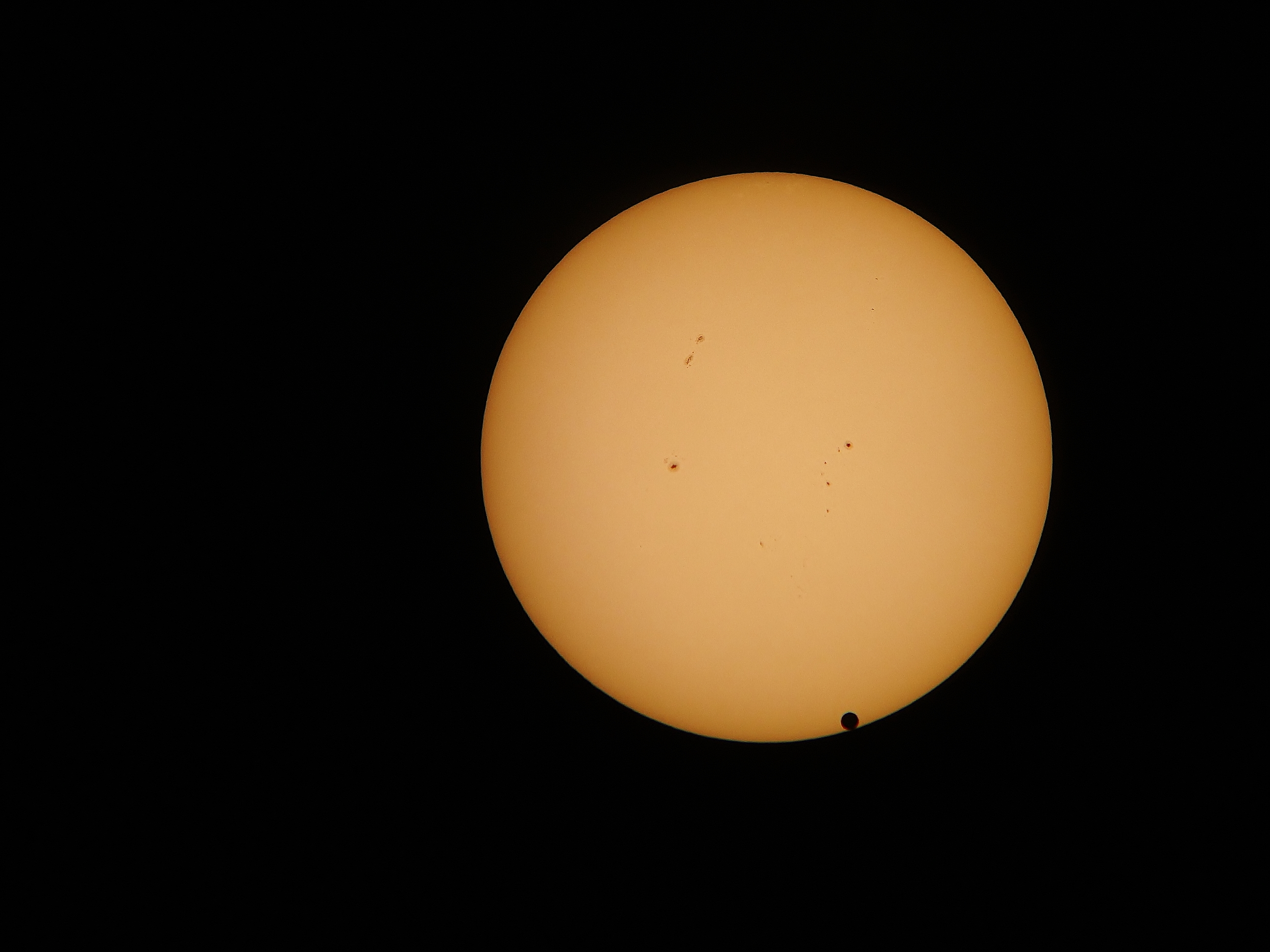
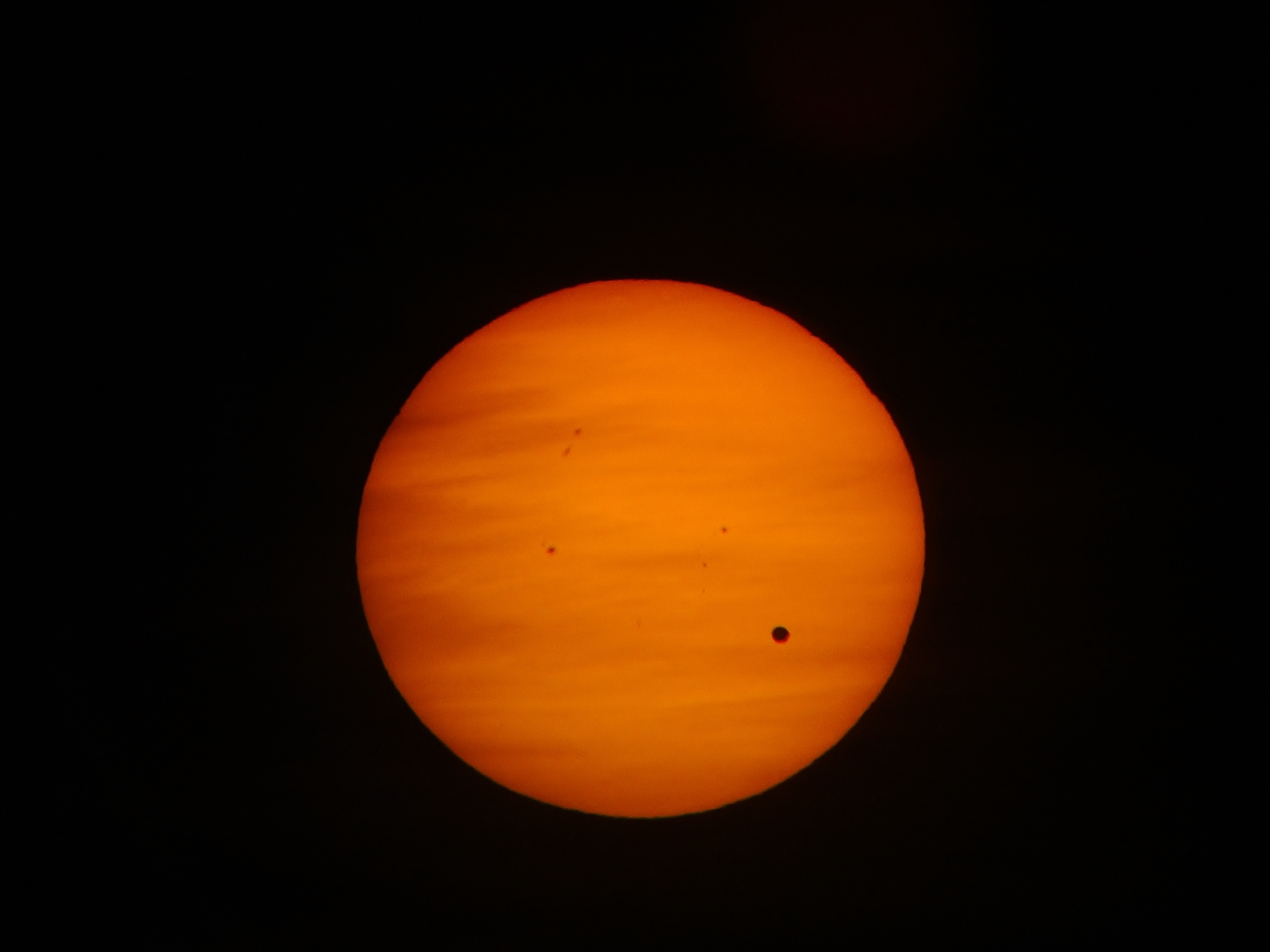
Wow, has it been that long already? I have been meaning to go through my photos and get a write up or two out of them. I visited the transit pics this morn and applied a little contrast, a little noise reduction, and a little shadow enhancement to hopefully tease out more detail.

I was able to catch the Venus transit 3 years prior to the 2012 transit visually, but was not ready for taking pics. By the time 2012 rolled around I was a little better prepared, not by a great deal, but enough to snap some pics. I used my trusty Orion ED 80mm apochromatic refractor telescope, with an Orion full aperture white light solar filter. The scope was mounted on a Celestron ASGT (Advanced Series Go To) mount, and I used a home made camera adapter that attaches to the eyepiece in the telescope, and holds the camera centered over the eyepiece. This process is known as afocal shooting. The camera is a little Sony Cybershot DSC-W200, 12.1 megapixel. Nuttin fancy, but you use what you have, especially when a good camera will cost you an arm and a leg.

I predetermined a prime location for shooting, and was there setting up in plenty of time. I thought. In addition to being rigged up for pics, I also setup a solar projection rig, so the family could watch the transit there, as I was busy getting pictures with the other telescope. The projection rig was a 90mm Orion achromat telescope, on a cheapo EQ II tripod with manual controls. I had it projecting onto a whiteboard, and it works great for this purpose. When you are setting up two telescope rigs, keeping the kids out of mischief, making sure two cameras are in working order (the wife took pics of the transit on the whiteboard too), and trying to find a few seconds to scratch your ass, time flies. By the time I was finally setup and had taken a few practice shots, the transit was beginning.

First contact. Where Venus meets the limb of the sun, roughly around 5:30. Click these pics for full size shots:

DSC00685 (2)

A little further along:

DSC00698 (2)

The mouse hole:

DSC00717 (2)

This one is known as the Black Drop, I was eager to catch this shot:

DSC00748 (2)

Clear of the limb with some passing clouds:

DSC00772 (2)

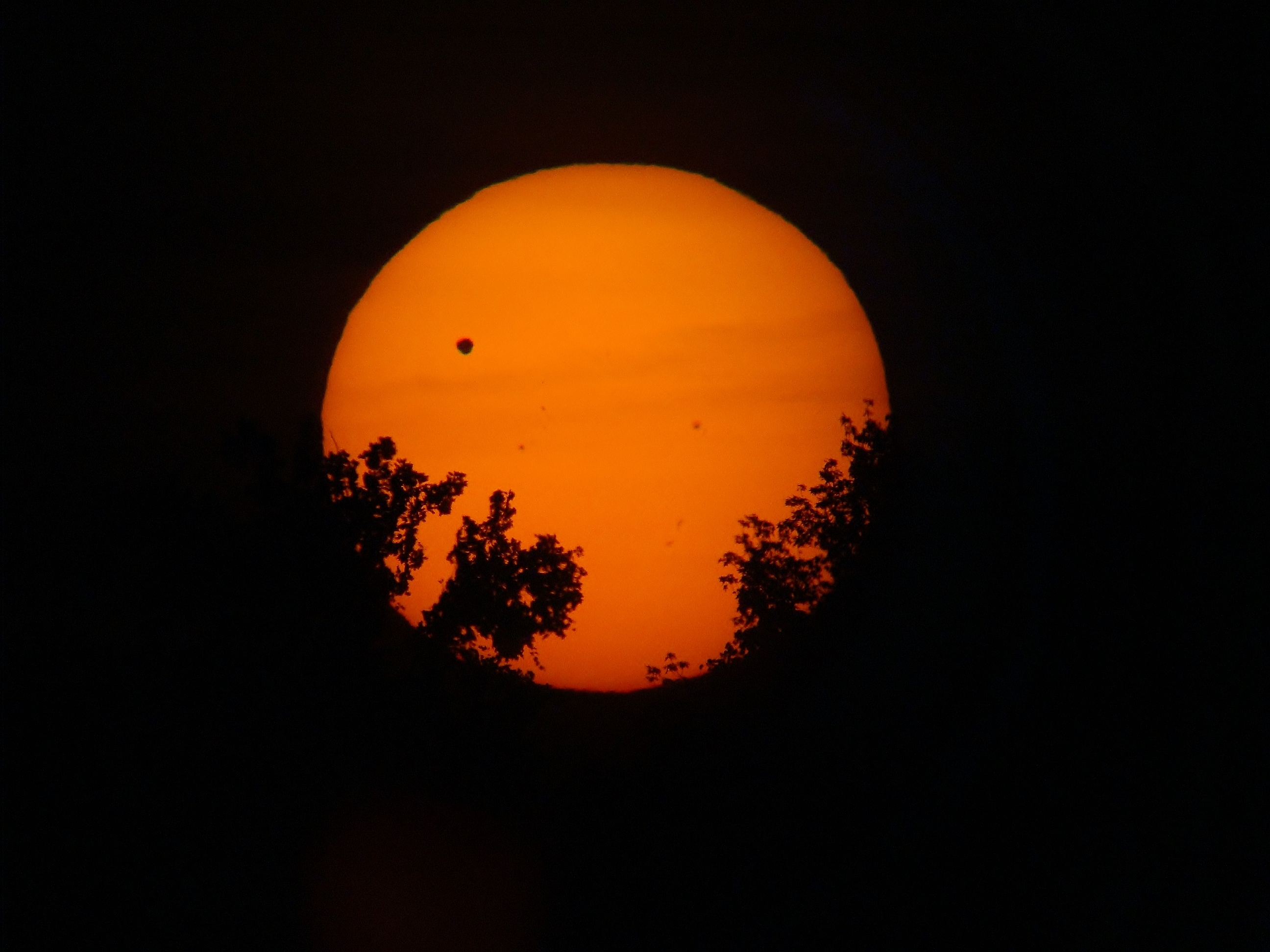
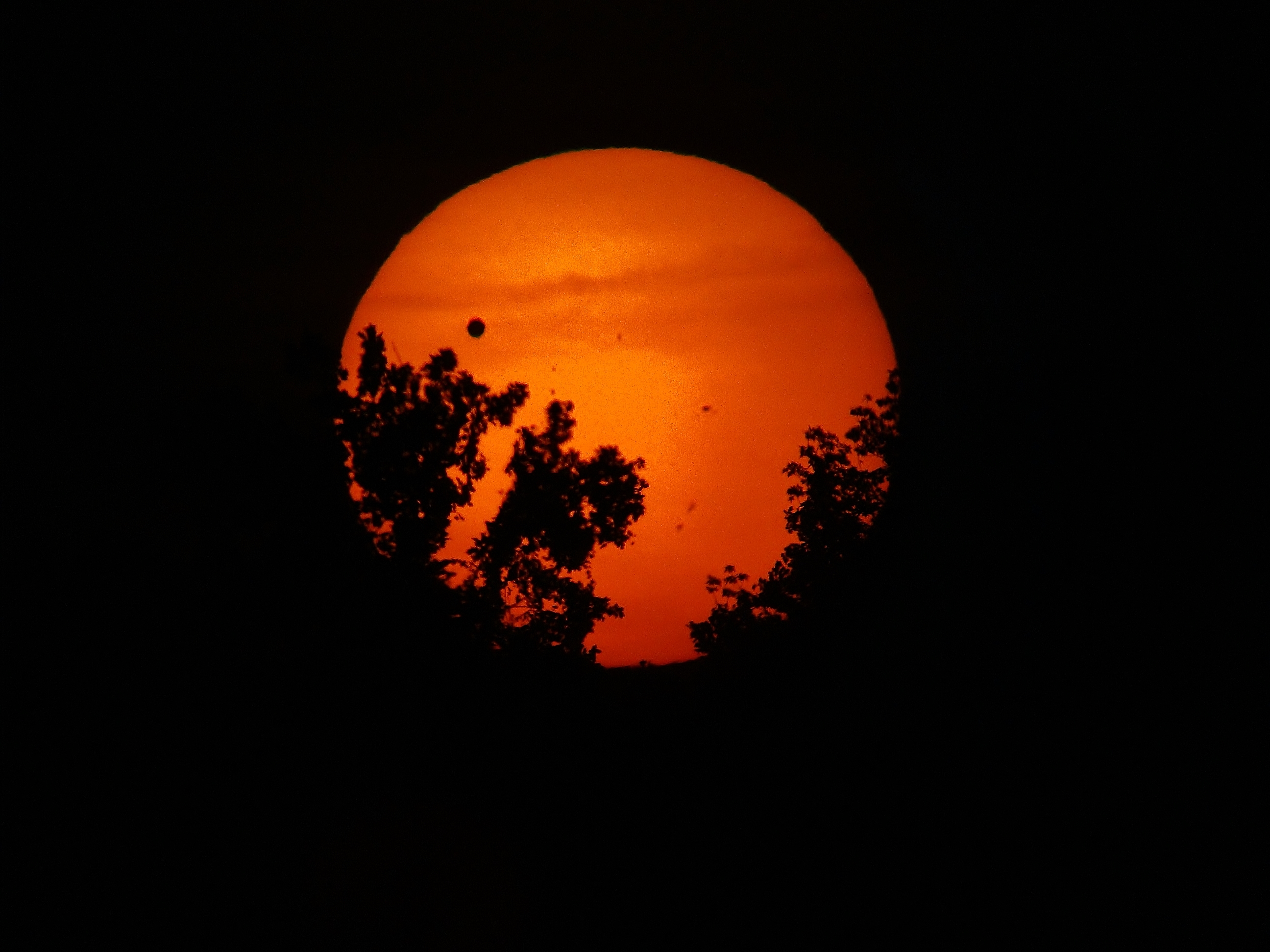
As the day progressed, I took around 130 pictures. How many pics of a black orb on the sun do you want to look at? The sun was soon getting low on the horizon and my transit time was running short, but some of the best shots of the day came with evening clouds moving in plus a lot of atmospheric distortion. The first two of the next six I call the Jupiter* and Venus** shots respectively:

DSC00876 (2) DSC00878 (2)

NextΒ you get first contact with the trees on the horizon. Once contact was made with the horizon, you will notice I had to invert the pics to give them proper perspective, putting Venus on the other side of the sun:

DSC00882 (2) DSC00885 (2) DSC00887 (2) DSC00889 (2)

That wraps it up. I hope you enjoyed it.

* Looking at Jupiter through binoculars or using low power in a telescope, it will show two prominent equatorial belts, similar to what you see here.

** Venus is known for its wispy cloud cover, which is what that pic inspired in me. For some Venus clouds click here:

https://www.google.com/search?q=venus+cloud+cover&espv=2&biw=1370&bih=752&site=webhp&tbm=isch&tbo=u&source=univ&sa=X&ved=0CCQQsARqFQoTCISN4ofU8cYCFQlLiAod8HEIuQ

Let’s Slow This Thing Down A Little Bit…

The universe that is. According to a Peter A. Milne of the University of Arizona, the standard for measuring universe acceleration, the type 1A supernova, is not quite as standard as they initially thought. There are at least two types of type 1A supernova detected in the recently accumulated data.

Apparently the trick, the key to the new data was looking at the supervovae in ultraviolet light. There is a different aspect noticed between ultraviolet andΒ visible light. They detected this difference with data from Swift, NASA’s orbital satellite with ultraviolet detectors, and compared them to observations from Hubbles visible light observations. The difference appears to be, and I’ll quote the source, first with our old data:

“The faraway supernovae should be like the ones nearby because they look like them, but because they’re fainter than expected, it led people to conclude they’re farther away than expected, and this in turn has led to the conclusion that the universe is expanding faster than it did in the past.”

Then with the new data:

“As you’re going back in time, we see a change in the supernovae population,” he added. “The explosion has something different about it, something that doesn’t jump out at you when you look at it in optical light, but we see it in the ultraviolet.

“Since nobody realized that before, all these supernovae were thrown in the same barrel. But if you were to look at 10 of them nearby, those 10 are going to be redder on average than a sample of 10 faraway supernovae. (edit:Β ReferringΒ to red shift/blue shift, basically red shift means it is moving away from us and blue shift moving towards us. There areΒ Β numerical increments that determine how far away an object is based upon its brightness. Which meansΒ we were getting false assumptions because of wrongly expectingΒ the supernovae were very similar)

The authors conclude that some of the reported acceleration of the universe can be explained by color differences between the two groups of supernovae, leaving less acceleration than initially reported. This would, in turn, require less dark energy than currently assumed.” (end quote)

What this all amounts to is, the universe while it is still expanding, may be expanding slower than we thought. They still have to crunch the numbers to see how much slower we are talking about. It also means we might get closer to understanding the amount of dark matter there is out there. As I understand it, with the previous observational data, there is too much dark matter to accurately account for. This finding could help resolve that issue. Which is cool, I’m always happy to see a missing piece of a puzzle fall into place. Especially when that piece gets us closer to understanding the things we don’t yet know. I came across this story @ Science Daily but the original source is here:

http://uanews.org/story/accelerating-universe-not-so-fast

So, Have You Seen The Sun Today?

I was going through my favorite list of links to visit just now, and I went here:

http://umbra.nascom.nasa.gov/images/latest.html

…to get my current picture of the sun fix. There are a couple of companies that manufacture Ha solar telescopes and I want one badly, so I looked at the Ha pic first, it is pretty good:

latest_aia_304

You can see all kinds of activity including a fewΒ enormous bursts, 8/9 and 11 o clock (roughly) And no doubt about the cool, or should I say hot of this picture. Then I clicked on the Fe IX/X filtered view and was just floored:

latest_aia_171

This filter shows you the magnetic loops in great detail. And there is a lot to look at. I was just blown away by these pics, and wanted to share. That link I posted is a great link to add to a browser, if you are inclined, I don’t want to twist any arms…